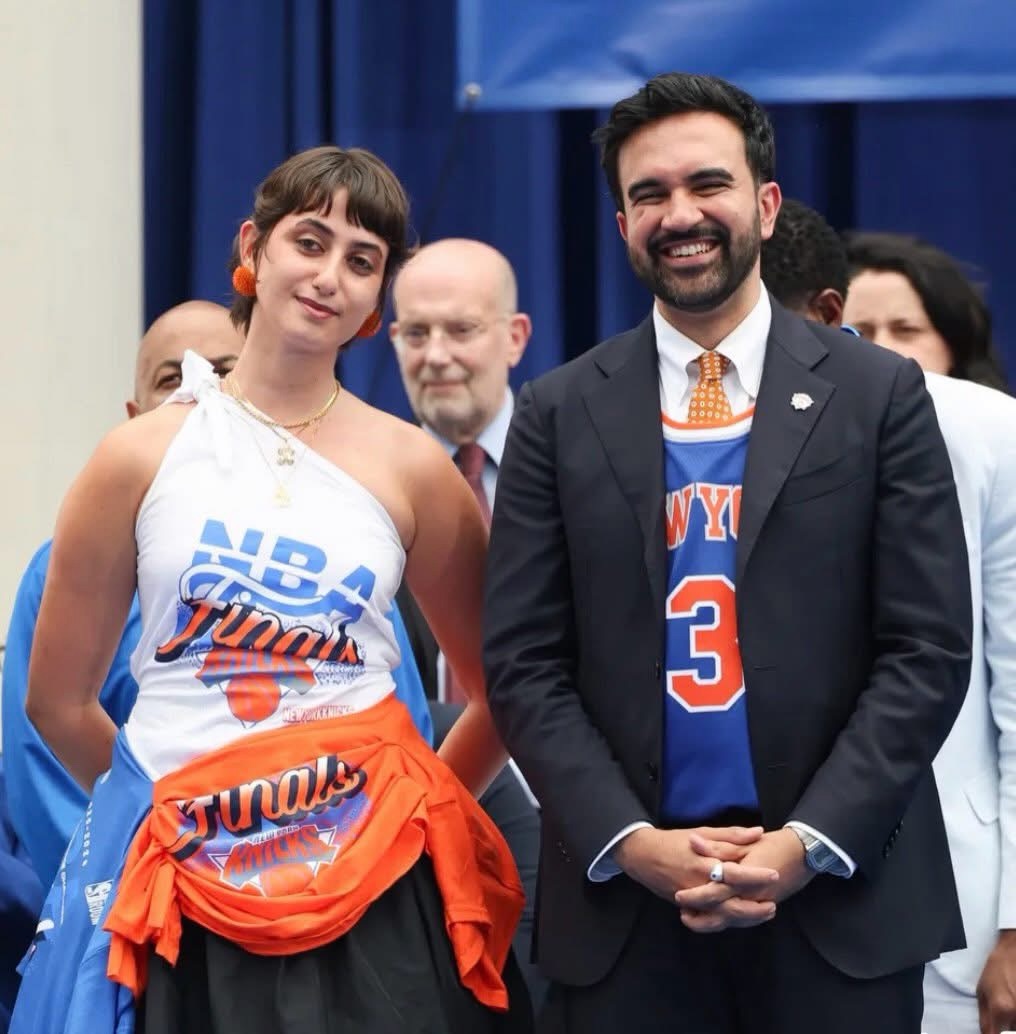
While New York Knicks fans lined up before dawn to celebrate the team’s first championship in 53 years, the city’s First Lady, Rama Duwaji, showed up wearing something that stopped style watchers in their tracks. Her parade outfit wasn’t a designer gown borrowed for the cameras. It was a custom dress upcycled from white, cobalt blue, and orange NBA Finals graphic tees…each one looking like it came straight off a local merch stand, restitched into a one-of-a-kind silhouette.
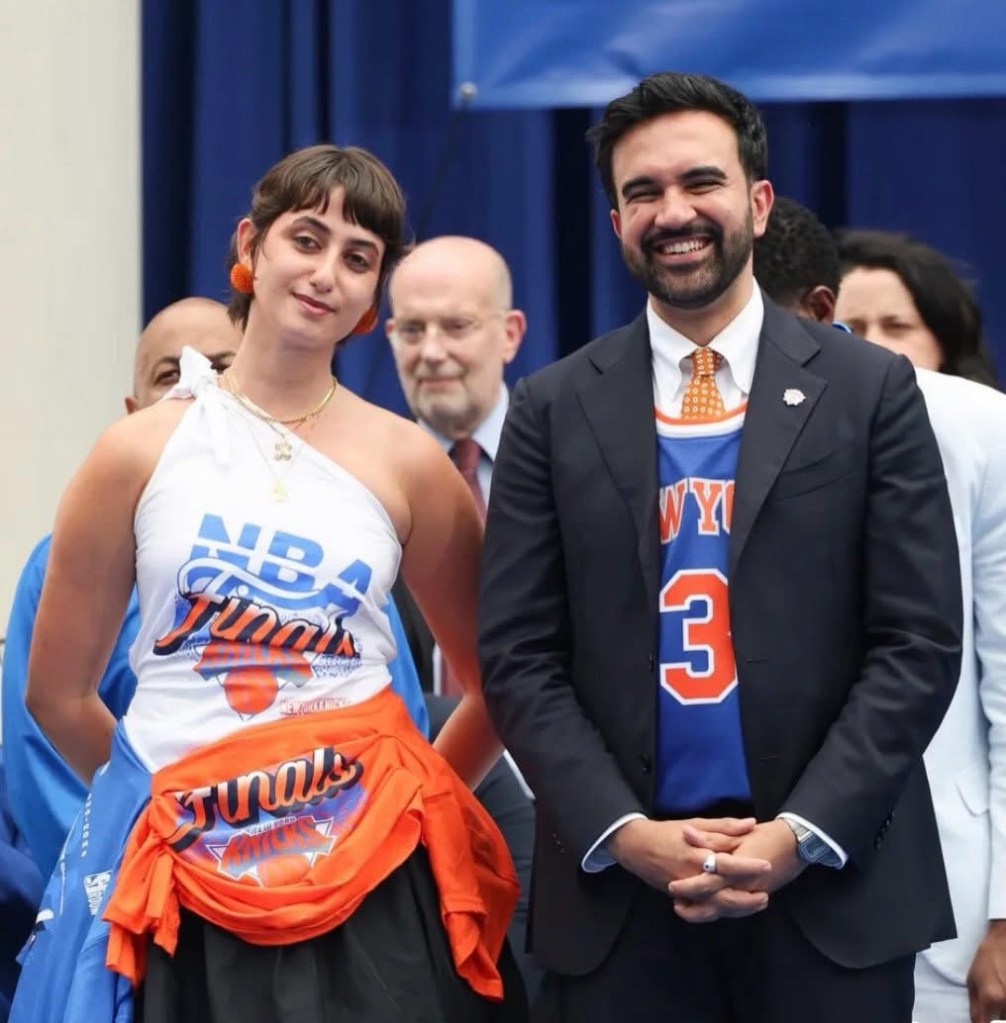
Rama Duwaji and Mayor Zohran Mamdani at the Knicks championship parade, June 18, 2026. The dress, by Miss Claire Sullivan, was upcycled from NBA Finals tees.
Photo: Kevin Mazur/ Getty Images
The designer? Miss Claire Sullivan, a 2026 CFDA/Vogue Fashion Fund finalist and an emerging name many people are only now discovering. Sullivan told Vogue she was inspired by the wave of Knicks gear turning the city’s streets blue and orange, tracking down shirts in every color with help from friends and reworking them into a dress. That instinct, to take what the culture is already wearing and elevate it into something singular, is exactly the kind of creative thinking we work to put in front of young people every day.
Here’s why this matters beyond fashion.
Rama Duwaji at the Knicks championship parade, June 18, 2026. The dress, by Miss Claire Sullivan, was upcycled from NBA Finals tees.
Photo: Kevin Mazur/ Getty Images
Rama Duwaji didn’t reach for the safe, recognizable label. She chose authenticity, and she chose a brand most of the public didn’t know yet. That decision did two things at once. It told her own story honestly, and it handed a rising designer a platform she might have waited years to earn. That is the whole game. Culture moves forward when people with visibility use it to lift the next person up rather than guard the spotlight for themselves.
At OSD (Obsessive Sneaker Disorder) and through SOLEcial Studies CommUNITY Academy, these are the lessons that we teach using the things young people already love — sneakers, fashion, media, and design. A T-shirt dress made from arena merch is a master class in storytelling, sourcing, design, and entrepreneurship rolled into one viral moment. When students see a path from “the gear I wear” to “a career I can build,” the conversation about life after high school changes completely.
It also connects to the work of Protect Our Culture. Culture is not a costume to borrow and discard. It is identity, memory, and economic opportunity, and it belongs to the communities that create it. When a public figure chooses an emerging, independent designer over a household name, this is culture being protected and reinvested in real time; it’s value flowing back to the maker, not just the brand machine.
For the young creators trying to find their footing, this is what platforms like The GRAIL’D exist for: giving the undiscovered designer, the self-taught stylist, the kid with a vision a place to be seen before the establishment catches on. Rama Duwaji proved that the most powerful thing you can wear is your own truth, and that lifting up someone new is never a risk to your image. It is the image.
Rama Duwaji and Mayor Zohran Mamdani at the Knicks championship parade, June 18, 2026. The dress, by Miss Claire Sullivan, was upcycled from NBA Finals tees.
There is no single road to success. Sometimes it starts with a stack of championship tees and the courage to make them your own.
What story is your style telling, and who are you lifting up while you tell it?
Credits
Dress designed by Miss Claire Sullivan — 2026 CFDA/Vogue Fashion Fund finalist.
Styling by Gabriella Karefa-Johnson
First Lady of New York City: Rama Duwaji
Original reporting: Vogue
 Protect Our Culture — Stories