
Back-to-school shopping has always been about more than notebooks, pencils and backpacks. For generations of young people, what you put on your feet on that first day has mattered, too. And maybe that makes the sneaker store one of the best places to start teaching our children about money.
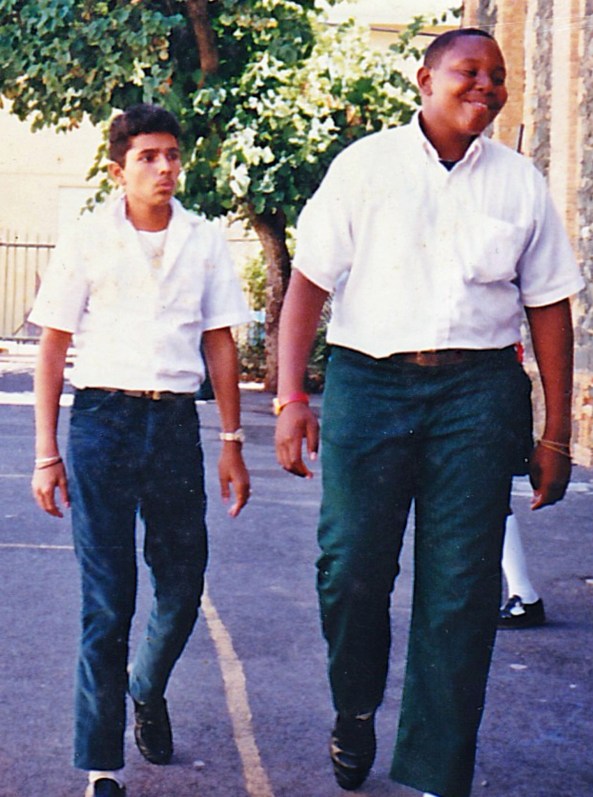
Growing up in the Virgin Islands, I wore a uniform to school.
That meant there weren’t a lot of opportunities to express yourself through what you wore. There were rules. And when it came to shoes, those rules usually meant black or brown.
But I’m obsessed with sneakers.
So I figured out a system.
I would wear my sneakers to school and change into my black or brown shoes before the first bell rang. Then, when school was over, I would change right back into my sneakers.
Sneakers. School shoes. Sneakers.
That was the routine.
Then I discovered something that changed the game for me: all-black Reebok EX-O-FITs.

They gave me the comfort of a sneaker while still working with what I was expected to wear to school. Eventually, they became part of my look. Other people noticed. What began as me finding a practical solution became something of a trend.
Looking back on it now, I realize there was already a lesson there.
Sometimes culture isn’t about wearing what everybody else tells you is cool.
Sometimes you find something that works for you, you wear it with confidence, and you help make it cool.
The First Day Has Always Mattered
Fast-forward to today.
Every August, parents and children across the country go through their own version of that conversation.
We talk about pencils, notebooks, backpacks, laptops, uniforms and school supplies.
But there’s another item on the back-to-school list that carries a different kind of weight.
The sneakers.
And if you’ve ever gone back-to-school shopping with a young person, you probably know the moment.
They find the pair.
Maybe they’ve seen somebody wearing it. Maybe their favorite athlete wears it. Maybe it’s been showing up on TikTok or Instagram. Maybe their friends are talking about it.
Or maybe they simply put it on, look down at their feet and think:
These are me.
Then the parent picks up the box, turns it around, and looks at the price.
Now two completely different conversations are happening at the same time.
The child is thinking:
I want to walk into school wearing these.
The parent is thinking:
I still have to buy everything else.
Neither one is necessarily wrong.
Confidence Has a Price Tag
An Associated Press report published during this year’s back-to-school season put numbers behind a conversation many families are already having. Shoe prices increased 3.2% during the first half of 2026, according to footwear-industry data cited by the AP. Children’s footwear sales declined while the number of pairs sold fell even more sharply, suggesting families are becoming more selective about what they purchase.
But the economics only tell part of the story.
Sneakers occupy a very different place in a young person’s life than a package of loose-leaf paper.
Sneakers are visible.
They can communicate style, interests, identity and belonging before a child ever says a word.
The AP’s reporting also examined that social reality, including the pressure some young people feel to wear particular sneakers and the confidence they associate with having shoes they like. It also documented the other end of the spectrum: educators seeing children wearing worn or damaged footwear because their families simply cannot afford replacements.
That’s why I don’t think the answer is to tell parents:
“Stop buying expensive sneakers for your kids.”
That’s too easy.
And I don’t think the answer is to tell young people that caring about their sneakers makes them materialistic.
That’s too easy, too.
For some parents, buying that pair is about more than a shoe.
Maybe you remember what it felt like when you didn’t have what the other kids had.
Maybe you remember walking into school self-conscious about your clothes.
Maybe you’ve worked hard because you want your children to have some of the things you couldn’t have.
There is nothing wrong with wanting your child to walk through those school doors looking good and feeling good.
Confidence matters.
The question is how we provide that confidence without allowing a sneaker purchase to put unnecessary pressure on the family.

The Sneaker Wall Can Become a Classroom
This is where our work with SOLEcial Studies Community Academy influences the way I see this conversation.
For years, we’ve used sneakers to help young people understand subjects that can sometimes seem disconnected from their everyday lives.
Business.
Design.
Marketing.
Entrepreneurship.
Culture.
And money.
Instead of fighting young people’s interest in sneakers, we can use that interest as the doorway to learning.
Back-to-school shopping gives parents an incredible opportunity to do exactly that.
Suppose your child wants a $160 pair of sneakers.
Instead of immediately saying yes—or immediately saying no—the conversation could start somewhere else:
“We have $100 budgeted for your school sneakers.”
Now we have a real-world financial problem to solve together.
If the sneaker costs $160, where does the additional $60 come from?
Maybe you wait for a sale.
Maybe you comparison-shop.
Maybe there’s another colorway that’s discounted.
Maybe last year’s model gives you essentially the same look for considerably less.
Maybe you look at an outlet.
Maybe you consider a reputable resale or secondhand option.
Maybe the young person decides to contribute $60 they’ve earned or saved.
Or maybe, after looking at all the choices, they find a $90 sneaker they actually like just as much.
We just turned a trip to buy sneakers into a lesson about budgeting, saving, comparison shopping, wants versus needs, trade-offs and value.
And nobody had to open a textbook.
This is SOLEcial Studies.
Understanding the Difference Between Price and Value
There’s another conversation young people deserve to understand.
Why does one sneaker cost $70 and another cost $170?

Sometimes there are legitimate differences in materials, technology, construction or performance, but sometimes we’re paying for something else.
The athlete.
The collaboration.
The designer.
The scarcity.
The story.
The logo.
The cultural meaning we’ve attached to the product.
Sneaker companies understand aspiration incredibly well. They understand the relationship between athletes, musicians, designers, social media and young consumers.
That’s marketing.
Understanding why you want something is financial literacy.
There’s a big difference between saying:
“I want those because everybody has them.”
and being able to say:
“I understand what they cost, I understand why I want them, and I’ve decided they’re worth spending my money on.”
That second young person is learning how to become a consumer rather than simply being consumed by marketing.
This is a lesson that will matter long after they’ve outgrown the sneakers.
Let Them Feel Good

I don’t want us to lose something important in all of this talk about budgets.
Kids should be excited about going back to school.
A new school year represents another beginning.
New teachers.
New classmates.
New opportunities.
And yes, sometimes a new pair of sneakers.
If putting on a pair they love gives a young person an extra little boost of confidence walking through those doors, I understand that.
I remember what sneakers meant to me.
I remember changing my shoes before that first bell.
I remember changing right back when school ended.
I remember discovering those all-black Reeboks and realizing that I could follow the rules, be comfortable and still feel like myself.
That’s what a lot of young people are really searching for when they’re standing in front of that wall of sneakers.
They’re asking:
“Which one feels like me?”
As parents, educators and people who care about young people, maybe our job isn’t simply to buy the shoe or refuse to buy the shoe.
Maybe our job is to help them understand the decision.
Set a budget.
Talk about the choices.
Let them participate.
Let them learn.
And when possible, let them walk into school feeling good about themselves.
Because someday they’ll outgrow that pair of sneakers.
But the lessons they learned buying them?
Those can fit for the rest of their lives.
Protect Our Culture believes the things we love can also teach us something. SOLEcial Studies Community Academy uses sneakers and the culture surrounding them as a gateway to education, financial literacy, entrepreneurship and career exploration.
 Protect Our Culture — Stories