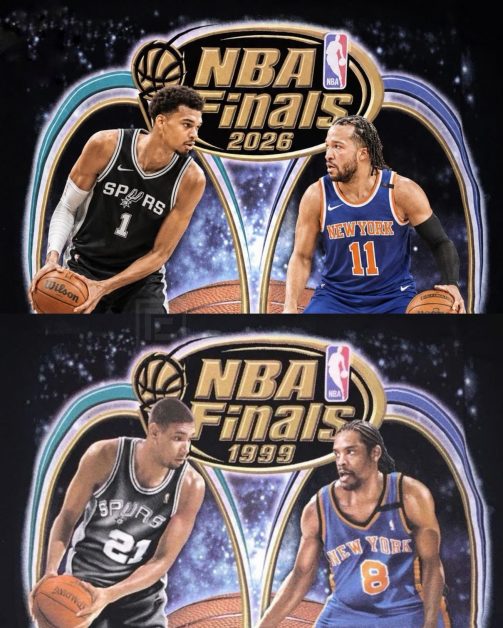
A 22-year-old from France is about to walk into the NBA Finals as the face of the San Antonio Spurs.

This lets us know everything about where the league is in 2026.
Spurs vs. Knicks. Game 1, June 3, in San Antonio. On paper, it’s a rematch of 1999 — Tim Duncan’s first crown, the Knicks’ improbable No. 8 seed run, Latrell Sprewell in the orange and blue wearing #8 on his back. We’re going to see the comparisons a lot this week, and I get why. It’s beautiful. It’s nostalgic. It rhymes.
But the nostalgia is the surface. Here’s what makes this bigger.
This Is a Global Product Now
Victor Wembanyama isn’t just a generational talent. He’s a marketing engine the NBA has been building toward for thirty years.

When Duncan and Sprewell met in ‘99, the league was still mostly selling America to Americans. By 2026, the Finals is a worldwide broadcast event with a French superstar at the center, beamed into living rooms from Paris to Manila to Lagos. The NBA figured out something other American leagues are still fumbling: the fastest way to grow isn’t a new city. It’s a new continent.

Wembanyama is the proof of concept. The Knicks are the most globally recognized basketball brand in the league’s biggest media market and there’re the perfect dance partner. This isn’t a regional rivalry anymore. It’s a global storytelling moment.
The Sneakers Tell the Same Story
You can read the entire history of this league through what’s on players’ feet.

In 1999, a sneaker deal meant a poster and a commercial. The shoe lived on the court and the playground. That was the whole map.
In 2026, the sneakers are global — a resale market, a collab calendar, a culture economy that moves in every timezone at once. When Wemby’s signature releases, it doesn’t just sell in San Antonio. It sells everywhere there’s a phone and a wish list. The sneaker stopped being footwear a long time ago. It became the most wearable piece of the league’s brand and the Finals is the biggest billboard it gets all year.
And the Invisible Player on the Court? Hip Hop.
Here’s the thread nobody puts in the box score.
In 1999, Hip Hop was the soundtrack…the arena music, the pregame walk, the culture bleeding in from the outside. By 2026, it’s not bleeding in. It’s the building.
The music, the tunnel fits, the language, the swagger — that’s hip hop. The way players are marketed, the way the league talks to a global audience that found basketball through the culture as much as the sport. That’s the invisible fifth starter. It never shows up on the stat sheet, but pull it out and the whole product collapses.
Spurs–Knicks in 1999 and Spurs–Knicks in 2026 aren’t really the same matchup. They’re two snapshots of the same machine — one local, one global — and Hip Hop is the through-line connecting both.
What I’m Actually Watching For
The basketball will be great. Wemby’s length against New York’s physicality. Jalen Brunson, the engine this Knicks team searched a generation to find, going to work in the fourth at the Garden.

The bigger story is the one happening off the floor…international star power, a sneaker economy that never sleeps, and a culture soundtrack carrying it all to every corner of the planet.
Twenty-seven years ago, this was a basketball game.
In 2026, it’s a global brand putting on its biggest show of the year.
Tip-off is June 3. Watch the game. But pay attention to everything around it.
This is where the real stories are.
What are the dots that you see through the NBA Finals…the basketball, the business, or the culture? I’d love to hear it.
 Protect Our Culture — Stories